



Menu
Your Cart

SparkFun ESP8266 Thing – Dev Board

SparkFun ESP8266 Thing – Dev Board
₹1,499.00
Ex GST: ₹1,270.34
  • Stock: In Stock
  • Model: 9270
  • SKU: SAT3440
  • Location: India

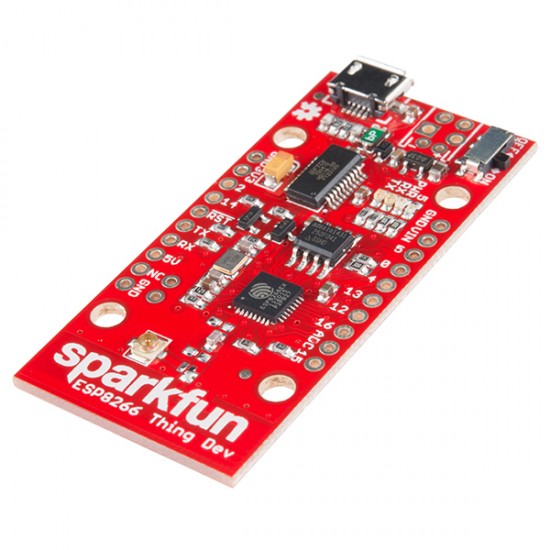
This is the SparkFun ESP8266 Thing Dev Board – a development board that has been solely designed around the ESP8266, with an integrated FTDI USB-to-Serial chip. The ESP8266 is a cost-effective and very capable WiFi-enabled microcontroller. Like any microcontroller, it can be programmed to blink LEDs, trigger relays, monitor sensors, or automate coffee makers, and with an integrated WiFi controller, the ESP8266 is a one-stop-shop for almost any Internet-connected project.

To top it all off, the ESP8266 is incredibly easy-to-use: the firmware can be developed in Arduino and uploaded over a simple, serial interface. The ESP8266 Thing Development Board breaks out all of the module’s pins, and the USB-to-serial converter means you don’t need any peripheral components to program the chip. Just plug in a USB cable, download the Arduino board definitions, and start IoT-ing.

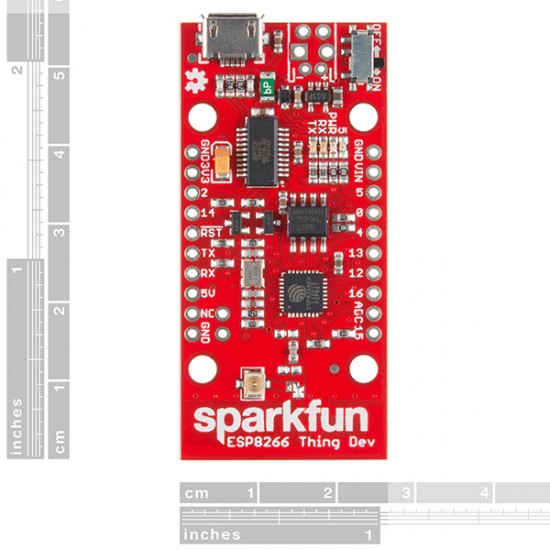
The ESP8266 Thing Development Board is a relatively simple board. The pins are broken out to two parallel, breadboard-compatible rows. The USB connector sits next to an optional power supply input, and an ON/OFF switch – controlling power to the ESP8266 – sits next to that. And LEDs towards the inside of the board indicate power, charge, and status of the IC. The ESP8266’s maximum voltage is 3.6V, so the Thing has an onboard 3.3V regulator to deliver a safe, consistent voltage to the IC.

That means the ESP8266’ I/O pins also run at 3.3V, you’ll need to level shift any 5V signals running into the IC. If your project requires a power source other than USB, the Thing Dev Board includes footprints for a 2-pin JST, 2-pin 3.5mm screw terminal, or a simple 0.1″-pitch 2-pin header. Unlike the original ESP8266 Thing, the ESP8266 Thing Dev Board does not have a built-in LiPo charger.

The Thing Dev Board even includes a PCB trace antenna as a default WiFi antenna, it’s cost-effective and actually works really well! If you need to connect a more sensitive antenna, or need to route outside an enclosure, a U.FL connector is also available on the board. Some soldering will be required to get the U.FL connector functioning but instructions can be found in the Hookup Guide we have written for the dev board.

6 Months Warranty

This item is covered with a supplier warranty of 6 months from the time of delivery against manufacturing defects only. This is a quality product from the original manufacturer. Only manufacturing defects are covered under this warranty. Reimbursement or replacement will be done against manufacturing defects.

What voids the warranty:

If the product is subject to misuse, tampering, static discharge, accident, water or fire damage, use of chemicals & soldered or altered in any way.

What is Customer Question & Answers?

Customer Questions & Answers allows you to connect with supplier to ask or answer questions about products. You can ask questions about a product or use your own expertise to answer other customers' questions.

What should I ask?

Ask questions specific to the product. This is a great opportunity to get feedback from other customers who have experience with the product. Ask a question that will capture this experience. For example:

  • Does this raspberry pi camera take good quality pictures in low light?
  • How long does the battery last, while flying quadcopter?
  • Does this robotic kit includes with batterys?

How should I ask?

[Click Here to ask]

Write a review

Please login or register to review